Canadian Owned |


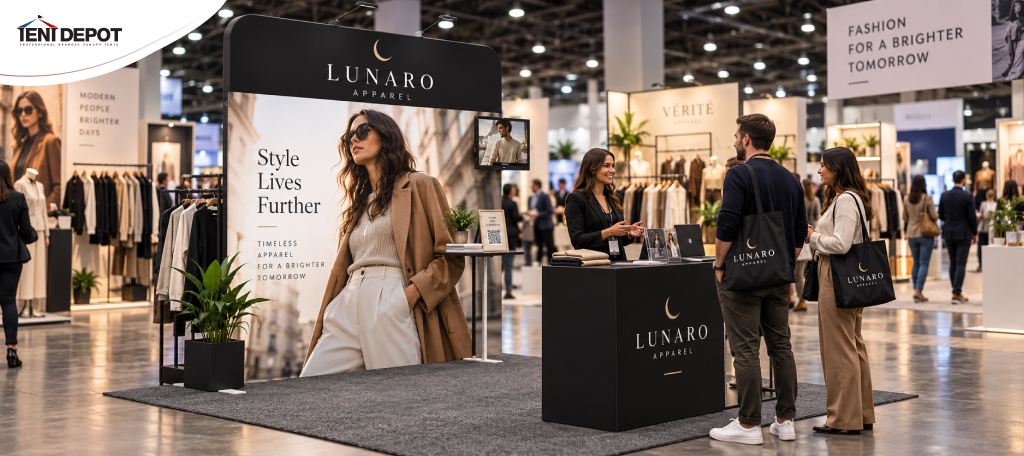
A first-time visitor walking down a trade show aisle who has never heard of your business takes a glance at your booth for a few seconds. Those few seconds can decide whether you are relevant to their interests and whether they should slow down or keep walking.
What they look at first is your trade show marketing material. These are the printed materials or digital assets that help shape the “stay or go” decision in around four seconds. They tell first-time visitors who you are, what you solve, and why they should stop. If they are convincing enough, they can turn a brief stop into a conversation, a potential customer, and a follow-up opportunity.
The stakes are worth considering. Research compiled from the Center for Exhibition Industry Research (CEIR) reports that 81% of attendees have buying authority, and Exhibit Surveys data cited by TSNN found that 67% of attendees are new prospects for any given exhibitor.
This short-form guide covers:
- The materials that matter most and the job each one does
- How to build a booth that moves visitors from noticing you to talking to you, including displays and interactive tools with real stopping power
- How to keep brand colours consistent across banners, tents, and table covers
- What Canadian exhibitors need to check before they order
Popular Product

|

|

|
Split of Trade Show Marketing Materials
Trade show marketing materials printed on fabric or graphic panels can be split into three groups based on the job they do:
- Pull people in from the aisle
- Hold a conversation
- Capture the lead
Below are examples of trade show marketing materials, their main purpose, and how far away they can be seen.
| Material | Main job | Seen from | Must get right |
|---|---|---|---|
| Backwall or tension fabric display | Say who you are and what you solve | 10–15 m down the aisle | One headline, logo high, no clutter |
| Hanging sign or tower | Help visitors find you in a crowded hall | Across the hall | Logo and booth number only |
| Retractable or pop-up banner | Frame the entrance and repeat the message | 3–6 m | Benefit headline above waist height |
| Branded tent or canopy | Provide the same visibility as a backwall outdoors | Across a parking lot or field | Weather rating, fire label, colour match to indoor kit |
| Table cover with logo | Make the counter look intentional | 2–3 m | Logo on the front panel, colour match |
| Product samples or demo screen | Prove the claim | At the booth | A 30-second version that works without staff |
| Sell sheet or brochure | Answer detailed questions | In hand | One page per offer, a QR code to the next step |
| Lead capture (badge scanner, QR form) | Turn a chat into a contact | In hand | Qualifying questions, not just an email |
| Branded giveaway | Help visitors remember your business later | Back at the office | Useful and tied to what you sell |
How First-Time Visitors Move Through Your Booth
Visitors meet your materials in a fixed order, and each piece only has to win the next step. Plan your booth around that sequence instead of buying items one at a time.
The aisle-facing graphics earn the stop, the closer pieces start the conversation, and the table is where interest becomes a contact. If any stage is missing, visitors may lose interest before reaching the next one.
Write for the First-Time Look, Not to Be Read
Ever noticed how some trade show graphics grab your attention instantly, while others barely get a glance?
A lot comes down to where you place your message.
Place your logo and a short, 3–7-word headline in the top third of the graphic so people can recognize your brand and understand the message at a glance. This also keeps the important text visible, since people, counters, and tables often block the lower three feet of a booth display.
To make the message easy to read, use strong contrast between the text and background, as mid-grey text on light grey can fade under convention centre lighting. Finally, choose one strong hero image that shows your product in action or highlights the result customers can expect.
After all, the goal isn't to make people read more. It's to give them a reason to look.
Get Your Artwork Ready for Printing
Imagine spending hours perfecting your booth design, only to receive a blurry logo or colours that look nothing like your brand.
That's why checking your artwork files before sending them to print is so important. Most large-format printers prefer vector logos (.ai, .eps, or PDF), fonts converted to outlines, images that meet the required resolution, and CMYK files with Pantone values for specific brand colours.
You can also check the printer's artwork guidelines to understand what is typically expected before submitting your files.
A few extra minutes spent checking your files can save you from expensive reprints and last-minute surprises.
Custom Trade Show Banners Canada: Make Every Impression Count
Ever noticed how some trade show banners grab attention while others go unnoticed?
For businesses shopping for custom trade show banners in Canada, retractable banners are a popular choice because they're portable, easy to set up, and reusable. A retractable banner stand can help frame your booth entrance or reinforce your main message. But getting the most out of one comes down to three things:
- Fabric vs. vinyl: Fabric reduces glare under exhibition lights and resists creasing, while vinyl is generally more affordable and suitable for outdoor use.
- Stand quality: Choose a reliable base that won't wobble, and check whether you can replace the graphics without buying a new stand.
- Your message: Keep it short. A bold headline, one product benefit, or a tempting offer is often enough to catch someone's eye.
Remember, your banner doesn't need to tell the whole story. It just needs to make visitors curious enough to stop.
Branded Trade Show Tents Canada: Give People a Reason to Stop
Ever walked through an outdoor event and spotted a colourful tent from far away?
That's what good branding can do for your business.
For businesses looking for branded trade show tents in Canada, a custom-printed canopy tent is a great way to get noticed at farmers markets, festivals, trade shows, and sporting events.
There are multiple ways you can use your tent to attract more visitors:
- Printed roof and valances: Add your logo and brand colours so people can easily find your booth.
- Branded sidewalls: Show off your products, share special deals, or tell people what your business offers.
- Matching table covers: Use the same colours and logo on your tables to bring your whole booth together.
- Promotional messages: Add a short headline or QR code to get people interested in your products.
Trade Show Table Covers with Logos: The Most Underrated Surface
Venues often supply a plain skirted table that clashes with everything else you brought. Custom trade show table covers fix that for a relatively small cost, and they sit at eye level for every conversation. These are available in fitted and stretch fittings for a professional look.
High-Impact Displays with Real Stopping Power
Flat graphics alone put you in a row of booths that all look alike. These displays can earn more attention per square metre because they give first-time visitors something to notice, move toward, or try.
| Display | Why it stops people | How to use it well |
|---|---|---|
| Message-driven backdrop | A benefit statement tells a stranger why to care; a logo only helps people who already know you | Lead with one line that names the visitor's main problem and your fix. Keep the logo smaller, in a top corner |
| Hanging signs, towers, and branded counters | Floating signs mark your spot from across the hall; vertical displays carry the message in an open booth without walling it off | Hanging sign: logo and booth number only. Tower or counter: headline at eye level |
| Modular backlit displays | LED-lit fabric or acrylic graphics glow against flat convention-hall lighting and stay readable from a distance | Put your core proposition on the lit panel. Proof colours on the backlit material itself, since light behind a graphic brightens and shifts it |
| Lighting and looping video | Motion and light catch peripheral vision before anyone reads a word | Short loops of 15–30 seconds, mounted above head height, with captions because halls are loud |
Businesses planning a complete exhibition setup can compare different trade show booth displays, including fabric backdrops, tension fabric displays, magnetic pop-up displays, tabletop displays, and backlit options.
Other Interactive and Experiential Tools
Once a visitor slows down, give them something to do. Doing beats reading, and every interaction is a natural opening for your staff.
Live demos and scheduled sessions. Let visitors handle the product, or run timed Q&A sessions and post the schedule on a sign ("Live demo every 30 minutes"). A touchscreen kiosk lets people watch demo videos, browse options, or submit a quote request even when every staff member is busy.
VR and AR. VR lets attendees tour a facility or see a product working at real scale when it is too big to ship. AR lets them scan a physical item and see live specs pop up on a tablet. Keep sessions to two or three minutes, with a staff member beside the headset so the experience ends in a conversation.
QR codes on every printed piece. Banner stands, retractable banners, flyers, postcards, and downloadable guides should all bridge to the web. Send each code to a page built for this show, and print it large enough to scan from where people stand. A common rule of thumb is a code about one-tenth as wide as the scanning distance, so roughly 30 cm across for 3 m.
Branded charging stations. A low phone battery is a real problem at an all-day show. A charging station solves it, keeps visitors at your booth for several minutes, and gives staff an easy, low-pressure way to start talking. Brand the station and add a QR code to it.
Trade Show Displays
A successful trade show setup brings different display elements together. Depending on your booth size and event requirements, you can combine a trade show booth package with banners, branded table covers, and other promotional materials to create a consistent presentation.
Make Every First Glance Count
The best trade show marketing materials work as one system. Graphics stop the visitor, a clear headline earns the conversation, matching colours make you look established, and a simple next step turns interest into a lead. Get the colour spec, the copy, and the venue rules right before you print, and the booth does more of the selling for you.
Ready to plan your next booth? Request a quote for colour-matched backwalls, banners, tents, and table covers, or order free fabric swatches to check your brand colours on the real material before you commit.
FAQs
What marketing materials do I need for a trade show?
At minimum: a backwall or main display, one or two banners, a branded table cover, a one-page sell sheet, a lead capture method, and a follow-up offer. Outdoor shows add a branded tent with walls and weights.
What should be on a trade show banner?
Your logo, one benefit-led headline, and optionally one offer or call to action. Keep the important words in the top half so they stay visible over people and tables.
How do I keep my brand colours consistent across trade show materials?
Create a colour spec with Pantone, CMYK, and HEX values, send vector files, approve a printed strike-off on the real material, and order all pieces from one supplier in one production run.
What is Pantone colour matching for trade show displays?
It is a process where the printer adjusts output to match a specific Pantone reference, usually checked with a spectrophotometer. It gets much closer than printing from a CMYK file alone, though a few very bright colours cannot be matched exactly.
Are fabric displays better than vinyl?
For indoor shows, fabric usually wins: no glare, lighter to ship, and it packs without creasing. Vinyl suits outdoor use and tight budgets.
Do trade show displays in Canada need to be fire rated?
Many major Canadian venues require fabrics and tents to meet CAN/ULC-S109. Check your exhibitor manual and ask your supplier for the certificate.
How far ahead should I order custom printed trade show displays?
Three to four weeks is a safe minimum. Allow extra time for colour strike-offs, French translations, and shipping across provinces.
What trade show displays attract the most visitors?
Displays that move, glow, or invite people to take part: backlit panels, looping video, hanging signs visible across the hall, live demos, VR or AR experiences, and charging stations. Pair them with a benefit-led headline so the attention turns into a conversation.