Canadian Owned |


If you're comparing a pole tent vs frame tent before booking or buying, the decision actually comes down to one mechanical difference that determines almost everything else, how each structure stands up in the first place.
That single difference decides what kind of ground you need, how much it costs, how much floor space you actually get to use, and how well it holds up in bad weather. Once you understand that core difference, every other tradeoff on this list makes a lot more sense, so let's start there.
A pole tent uses center and side poles with guy lines and stakes to create tension that holds the fabric up, which means it needs soft ground to anchor into. A frame tent uses a rigid, self-supporting aluminum or steel structure instead, so it doesn't need interior poles or ground staking at all, which is why it works on pavement and patios where a pole tent can't go.
Pole tents cost less and set up faster with fewer parts. Frame tents cost more but give you open interior space and better performance in wind, rain, and snow.
How Each Structure Actually Holds Itself Up
This is the mechanical difference behind the whole frame tent vs pole tent comparison, and it explains everything else that follows. A pole tent relies entirely on tension to exist as a structure.
Center poles push the fabric peak upward, side poles support the perimeter, and guy lines running from those poles to ground stakes pull everything taut. Without that tension, the canopy has no structural integrity at all, which is why stakes go in first during setup, not last, since the tent can't stand on its own until that tension system is in place.
A frame tent works the opposite way. Interconnected aluminum or steel poles and fittings bolt together into a rigid, self-supporting chassis before the fabric ever goes on. The canopy then attaches to that already-standing frame using buckle straps along the edges, and because the structure holds itself up independently, staking or ballasting becomes one of the last steps rather than the first.
This is the reason frame tents can go places pole tents can't, the structure doesn't need the ground's help to exist.
Anchoring and Ground Requirements
This is where the two categories diverge most in practice, and it's usually the deciding factor for most buyers. Pole tents need a permeable surface, grass or a soft field, since the stakes have to be driven securely into the ground to maintain the tension holding everything up.
That means concrete, asphalt, or a paved patio is off the table unless you bring in specialized ballast systems, and even then, you won't get the same performance as proper staking in real ground. Heavy rain adds another layer of risk here, since saturated soil loosens stakes fast, and once those stakes give even slightly, the entire tensioning system starts to fail with them.
Frame tents avoid this problem entirely, since they don't need staking to stand, which is exactly why parking lots, rooftops, and paved plazas become usable venues. That doesn't mean no anchoring at all, though.
Frame tents still need weighting or ballast for wind stability once they're on hard surfaces, so you're trading one anchoring requirement for a different one, not skipping it.
Interior Space and Sightlines
Interior layout is where the two styles look most different once you're actually standing inside one. The center poles that give pole tents their signature soaring peaks and sweeping curves are also sitting directly inside your usable floor space. That means every seating chart, dance floor layout, or stage placement has to work around those poles, which becomes a real constraint once you're trying to fit a specific number of tables into a specific footprint.
Frame tents remove that constraint completely, since the rigid perimeter structure means zero poles anywhere inside the tent. That gives you a fully open, unobstructed floor plan, a genuinely useful advantage for large seated events or any layout that needs real flexibility in furniture placement.
Setup Time, Crew, and Site Footprint
Setup complexity follows directly from how many parts each style actually has. Pole tents use fewer individual components overall, side poles, center poles, guy lines, and stakes, with larger sizes adding quarter poles and stake plates for extra stability. Fewer parts means faster setup, and easier transport and storage too.
Frame tents involve considerably more hardware by comparison, fittings, connectors, and support bars that all bolt together piece by piece, which generally means a bigger crew and more assembly time. There's also a footprint detail worth knowing before you book a site: a pole tent's actual required space extends well beyond its stated dimensions, since industry guidance recommends adding roughly 7 feet of clearance beyond the canopy edge for the stake line.
A 40x80 tent realistically needs a 50x90 site, not a 40x80 one. Stake spacing follows its own rule too, roughly 5 feet out for 7-foot side poles, 6 feet out for 8-foot poles, driven vertically for the best holding strength. Frame tents skip that stake perimeter requirement entirely, making them the more space-efficient choice on a tight site.
Weather Performance
Weather performance is where these differences actually get tested on event day. A properly staked pole tent handles wind reasonably well, since the tensioned design spreads that load across the whole anchoring system, and it manages rain fine too, though prolonged snow sitting on that peaked fabric roof needs active management rather than being left alone.
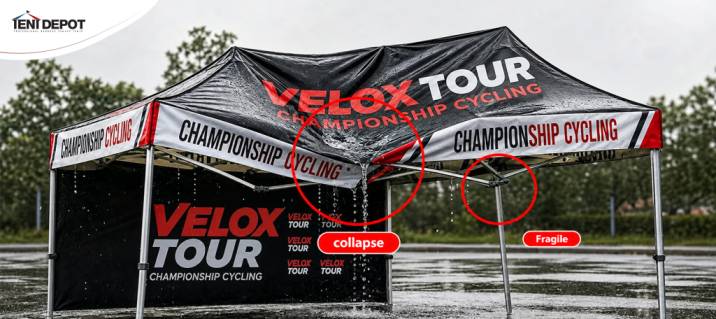
Frame tents generally handle sustained heavy weather better overall. The rigid structure combined with proper ballast manages wind more predictably on hard surfaces, and the sturdier frame deals with heavy rain or snow load with fewer interventions required during the event.
Cost and Long-Term Value
Cost is usually where this comparison starts for most buyers, so here's the direct answer. Pole tents are generally the more affordable option upfront, which matters most for a one-off event or a tighter budget. Frame tents cost more initially because of the metal framework and fittings involved, but that extra cost tends to pay off through versatility, since you can now use hard-surface sites a pole tent simply can't touch, and that durability holds up across more repeat installations over time.
Which Should You Choose?
Choose a pole tent if you have grass or soft ground, prefer the traditional aesthetic, are working with a tighter budget, and need it for a shorter-term booking. Choose a frame tent if you're dealing with pavement or a mixed-surface site, need a fully open interior, or care more about wind, rain, and snow performance than upfront cost.
If what you actually need is a portable, branded structure rather than a full event-rental tent, that's a slightly different problem. Tent Depot's custom printed canopy tents are built for exactly that, a fast, tool-free setup with full-color branding for markets, trade shows, and outdoor promotions. For a deeper look at the canopy side of this comparison specifically, Tent Depot's own canopy tent vs frame tent guide covers that adjacent decision in more detail.
Frequently Asked Questions
Can a pole tent be installed on concrete?
Not without specialized ballast systems, and even then you won't get the performance of proper ground staking, since pole tents are built for grass or soft-ground sites.
Why do frame tents cost more than pole tents?
The aluminum or steel framework needs more components, fittings, and assembly labor than a pole tent's simpler pole-and-line system, and that extra complexity shows up in the price.
Which option handles wind better?
Frame tents tend to perform more predictably in sustained wind, especially on hard surfaces once properly ballasted, though a correctly staked pole tent still handles wind well on the right kind of ground.
Do frame tents really have zero interior poles?
Yes, the entire structure supports itself through its perimeter frame alone, which gives you the fully open floor plan a pole tent's center supports can't offer.