Canadian Owned |
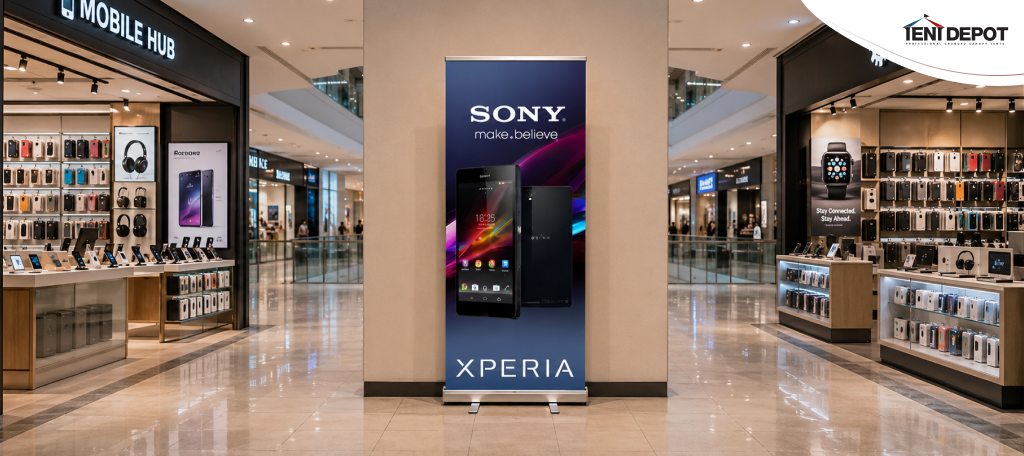
You have paid for the booth space, shipped the display, briefed the team, and shown up ready. The event opens. Hundreds of people walk the floor and most of them walk straight past you. Not because your product is wrong for them. Because nothing in the first three seconds of seeing your setup gave them a reason to stop.
That is the real problem most exhibitors never solve. They invest in the booth and forget to invest in the signal.
In this guide, you will find practical, psychology-backed banner stand ideas that change that covering design, placement, messaging, and the display choices that actually shift foot traffic in your direction.
Why Most Banner Stands Fail Before Anyone Reads Them
Before getting into ideas, it is worth understanding why the average banner stand produces average results. The most common failures are not about the product, they are about how it is used.
- Too much text forces the viewer to work. A busy convention floor is not a reading environment. If your banner requires five seconds of reading to understand, most people will not give it those five seconds.
- Small headlines that only make sense up close mean the banner does nothing for the 80% of attendees who pass more than six feet away.
- Generic stock imagery signals a brand that did not put thought into its presentation.
- No clear call to action leaves the interested visitor with no obvious next step.
The banner stand is not the problem. What goes on it and where it goes usually is.
The Psychology Behind Banners That Actually Stop People
High-performing banner stands apply a few principles that most exhibitors overlook entirely.
Visual Hierarchy
Visual hierarchy determines what the eye sees first, second, and third. If your logo is the largest element on the stand, you have used that hierarchy slot on the element that does the least persuasive work. A benefit statement or a bold outcome should occupy the first visual hit supported by the logo alone.
The Three-Second Rule
The three-second rule is not a design guideline. It is a biological reality. The human brain makes an initial judgment about a visual scene in under three seconds. Your banner needs to communicate its primary message within that window from a distance of at least six feet. If it cannot, it is functioning more like wallpaper than a banner stand.
Color Contrast
Color contrast does more persuasive work than most marketers realize. High-contrast color combinations such as dark backgrounds with light text, or bold accent colors against neutral fields, register faster at distance than low-contrast designs regardless of how sophisticated the low-contrast version looks on a screen. At an event with competing visual noise from every direction, contrast is clarity.
Cognitive Load
Cognitive load is the volume of mental effort required to process what you are looking at. Every additional element you add to a banner stand increases cognitive load. The best-performing banner stands at trade shows in 2026 are frequently the most stripped-back with:
- One headline
- One supporting visual
- One action
15 Marketing Banner Stand Ideas That Shift Foot Traffic
The ideas below are not about making your banner stand look better. They are about making it work harder. Each one addresses a specific reason why attendees stop, engage, or walk past and gives you a practical way to influence that decision before your staff says a word. Some of these will confirm what you already know. Others are the ones your competitors have not figured out yet.
1. Lead with a Specific Outcome, Not Your Company Name
"Reduce your event setup time by half" outperforms "Welcome to Company Name" at every stage of the three-second decision. Attendees are not looking for a name; they are looking for relevance.
2. Use Before-and-After Visual Pairs
Two images side by side, problem state and solution state, communicate transformation faster than any amount of copy. Service businesses, product brands, and healthcare companies all use this with measurable impact.
3. Embed a QR Code with a Specific Destination, Not Your Homepage
A QR code on your retractable banner stand should land on a page built specifically for that event. It can be a limited-time offer, a lead form, or a product video. A QR code going to a homepage tells the visitor the brand did not make the connection between the display and the follow-through.
4. Put Your Strongest Customer Result in Quotation Marks
Social proof formatted as a direct quote stops the eye more reliably than a bullet list of features. One specific result from one specific customer outperforms a list of five generic benefits every time.
5. Use a Single Lifestyle Image at Full Bleed Instead of a Product Shot
At distance, a full-bleed lifestyle image of a person in context registers faster than a product on a white background. The viewer places themselves in the image before they consciously process what they are looking at.
6. Match the Banner Messaging to the Specific Event Audience
A general banner about your company performs below a banner with copy written for the specific industry or audience at that show. A staffing company exhibiting at a healthcare conference should have a banner that speaks to healthcare workforce challenges, not general staffing.
7. Use a Double-Sided Banner Stand in Queue and Walkway Positions
Our double-sided banner stands present different content on each face, which doubles the messaging reach in positions where attendees approach from both directions. Most exhibitors use single-sided stands in positions that serve two traffic directions simultaneously.
8. Design for a Six-Foot Reading Distance, Not a Screen
Most banner stand graphics are designed at full resolution on a monitor and approved on a laptop screen. The person who will read it at the event is standing six to ten feet away.
- Minimum readable headline size at that distance is 72pt.
- Sub-headlines should be no smaller than 36pt.
- If you cannot read the key message from six feet in the design file, it will not read on the floor.
9. Add a Lead Magnet Offer Directly on the Stand
"Scan to get the 2026 Event Marketing Checklist" performs better than "Learn More." Offering something specific and immediately valuable in exchange for a scan or a conversation changes the visitor's calculation from interest to intention.
10. Place a Table Top Banner Stand at Counter Height
A floor-standing banner behind the table is seen from across the room. A table top stand beside the point of conversation is seen by the person you are already talking to while reinforcing the key message at exactly the moment they are most receptive.
11. Use Event-Specific Copy on a Second Stand Dedicated to the CTA
Two-stand setups where one carries the brand message and the other carries the specific event offer consistently outperform single-stand setups trying to do both jobs. The first stand earns attention. The second stand converts it.
12. Rotate the Display Position Mid-Event
Convention hall foot traffic patterns shift between morning and afternoon sessions. A banner stand positioned optimally for morning registration traffic may face the wrong direction for afternoon session breaks. Repositioning mid-event is free and overlooked by almost everyone.
13. Use an Outdoor Banner Stand at Venue Entrance and Car Park Positions
Most exhibitors wait for attendees to reach the floor before beginning brand communication. Placing a weatherproof outdoor banner stand at the venue entrance or car park establishes recognition before the attendee has seen a single competing booth.
14. Create a "Who This Is For" Headline Instead of a "What We Do" Headline
Specificity about the audience does more filtering work than specificity about the product. "For marketing managers spending over $50K on events annually" stops the right person more reliably than "Event Marketing Solutions."
15. Coordinate the Banner Stand Graphic System with Your Table Covers and Canopy Tent
The exhibitors who consistently out-convert on busy event floors run a single visual system across every touchpoint. Banner stands, table cover, tent, and flags all carry the same color palette, typography, and graphic language. The booth reads as a brand environment rather than a collection of separately ordered display items.
Matching Banner Stand Types to Your Event Goal
| Event Goal | Best Banner Stand Format |
|---|---|
| High foot traffic identification | Premium retractable banner stand — tall, bold headline |
| Directional wayfinding | Outdoor banner stand or X-frame at entrance points |
| Counter-level messaging | Table top banner stand at the conversation point |
| Two-sided traffic positions | Double-sided banner stand |
| Multi-event traveling setup | Scrolling banner stand or budget retractable |
| Outdoor events and promotions | Weighted outdoor banner stand |
| Photography and media backdrops | Step and repeat banner stand |
Banner Design Checklist Before You Send to Print
Run through this before approving any banner stand artwork:
- Headline communicates a specific outcome or audience, not a company name.
- Logo is present but not the dominant element.
- Primary message readable from 6 feet at minimum.
- Single clear call to action. Ask for one action, not three at one time.
- QR code links to a specific event-relevant landing page only.
- High contrast between background and text throughout.
- No more than 3 font sizes used across the full design.
- Image is high resolution (300 DPI minimum at print size). (100 to 150 DPI is best for large outdoor banner.)
- Whitespace is intentional. Not every area needs to be filled.
- Brand colors are consistent with every other display element at the booth.
Where You Place Is As Important as What Is on It
The highest-performing banner stands are rarely in the most obvious positions. Booth entrance flanking is standard; every booth does it. The placements that produce disproportionate results are the ones most exhibitors overlook.
Queue Lines
Queue lines hold captive audiences with no competing visual demands. A banner stand beside a registration queue or a food and beverage line has the full attention of a stationary person with nothing else to look at.
Reception and Lobby Areas
Reception and lobby areas reached before the show floor opens communicate brand identity to attendees before they have seen any competing exhibitor.
Stage and Session Room Entrances
Stage and session room entrances capture the highest-interest attendees at the moment they are most engaged with the event content.
Washroom and Elevator Corridors
Washroom and elevator corridors are placed on the high-traffic routes that every attendee uses regardless of which exhibitors they plan to visit.
Measuring Whether Your Banner Stand Is Working
Most exhibitors measure trade show success by lead count at the end of the show. That tells you the total result but nothing about which elements drove it. Three measures that tell you more:
- QR code scan rate per hundred visitors passing the stand. If the stand is in a high-traffic position and scans are low, the offer or the graphic is not compelling enough to produce the micro-commitment of a scan.
- Conversation opener data from your staff. What percentage of conversations were initiated by the visitor versus the staff? A high visitor-initiated rate means the stand is doing its job.
- Unaided recall testing. Ask leads at the end of the day what they remember about your booth without prompting. The elements they recall without prompting are the ones that did the most work.
Build the Complete Setup Around Your Banner Stand
A banner stand works hardest as part of a coordinated display environment. Pair yours with a custom trade show booth display at the back wall, a branded table cover at the front engagement point, and storefront flags at the booth perimeter.
Each element covers a different visibility range. If flags work at distance, the booth display works from the aisle, the banner stand works at conversation range, and the table cover works at interaction distance. When all four carry the same visual system, the booth functions as a coherent brand environment rather than a set of individually ordered display products.
Every Event Is a Limited Opportunity
Every event is a window that opens and closes in a matter of hours. The brands that use that window well come prepared with a display system designed for the specific audience, the specific venue, and the specific goal of that show.
Call us toll free at 1-877-409-0265, email info@tentdepot.ca, or order online at tentdepot.ca.
Important Note: Orders placed before 1:30 PM ship the same day.
Frequently Asked Questions
What is a marketing banner stand and how is it different from a regular banner stand?
A marketing banner stand is a banner stand used with deliberate intention toward a specific commercial goal like generating leads, communicating an offer, driving booth traffic, or reinforcing brand messaging at a specific audience. The difference from a decorative or informational banner is in the design strategy: a marketing banner stand is built around a specific viewer action, not general brand presence. The hardware is the same. The design intent and the placement strategy are what change the outcome.
What should I put on a marketing banner stand to get results?
One benefit-driven headline written for the specific audience at that event, one supporting visual that shows an outcome rather than a product, one social proof element such as a result or a quote, and one clear call to action with a specific destination. Everything else is secondary. The most common mistake is treating the banner as a place to put everything the brand wants to say rather than the one thing the viewer needs to hear to take the next step.
Which banner stand works best for trade shows?
Premium retractable banner stand models are the most practical format for standard trade show booth use. They are tall, stable, fast to set up, and produce a professional graphic presentation. For booths in positions with two-direction foot traffic, double-sided banner stands cover both approach directions from a single unit. For exhibitors who also need outdoor positioning at the venue entrance or car park, a weighted outdoor banner stand handles weather conditions that standard retractable formats cannot.
How long do banner stands last and are they worth the investment across multiple events?
A premium retractable banner stand with a quality cassette mechanism and a durable graphic is designed for repeated use across multiple events. The hardware typically outlasts several graphic cycles. When a campaign updates, the graphic is replaced and the hardware continues. For businesses attending three or more events per year, the cost-per-use of a quality banner stand over two to three seasons is significantly lower than single-use or short-lifespan alternatives.