Canadian Owned |
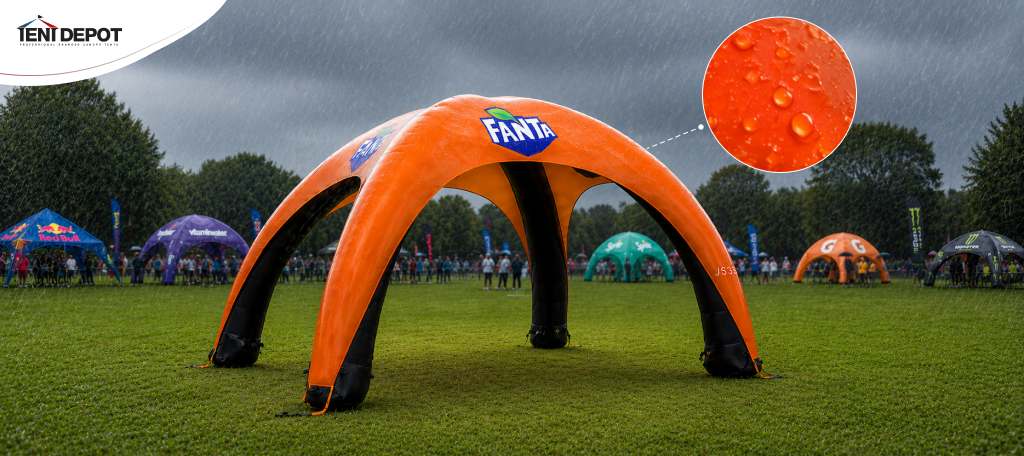
Imagine spending weeks planning an outdoor event, only for unexpected rain to soak your promotional materials, damage expensive equipment, and send visitors running for cover. Choosing the wrong tent doesn't just ruin an event, it can cost your business leads, revenue, and reputation.
That risk is a little more real here than in most places. Canadian outdoor events run on a compressed, high-stakes calendar: Calgary Stampede in July with its notorious chinook-driven wind swings, Osheaga and Just For Laughs in Montreal, the Canadian National Exhibition on Toronto's lakeshore where wind off the water is a given, and a farmers market and festival season that, for most of the country, only really runs from the May long weekend to Thanksgiving. There's no second chance if the tent fails on the one weekend it was booked for.
This guide will show you exactly how to choose a waterproof inflatable tent that performs when the weather doesn't.
Quick Answer
A truly waterproof tent is made from PU or PVC-coated polyester with a hydrostatic head rating of at least 1,500mm, fully sealed or welded seams, and a frame built to hold its shape under wind and rain load. The best waterproof inflatable tents combine coated 600D polyester with air-beam construction, which flexes under gusts instead of bending or snapping, giving reliable shelter for trade shows, sporting events, festivals, and outdoor promotions across a Canadian event season. Tent Depot's inflatable tent lineup is built around exactly this combination.
That's the short version. The longer version starts with why this decision matters more than most buyers assume, before they've actually stood under a failing tent in the rain.
Why Waterproof Matters More Than You Think
It's tempting to treat "waterproof" as a nice-to-have feature rather than the feature. But walk through what actually happens when a tent isn't up to the job, and the priority becomes obvious fast.
Water finding its way through a seam or a thin canopy doesn't stay contained to the roof. It runs down onto whatever is underneath it: damaged inventory that can't be sold once it's wet, ruined marketing materials and printed graphics that were supposed to last the whole event, electrical equipment that becomes a genuine safety hazard the moment moisture reaches it, and in the worst cases, an event cancellation that refunds a day of revenue you were counting on. None of that accounts for the visitors who leave the moment they get wet, or the impression left on a customer who walked into your booth at a summer festival expecting shelter and found none.
A tent isn't shade with a logo on it. For a business exhibiting outdoors, it's the difference between a controlled environment and an open field, and the waterproofing is what keeps that difference intact once the weather turns, which in Canada can happen with very little warning.
Once you accept that the stakes are real, the next step is knowing what a failing tent actually looks like before you've bought it, not after the first storm rolls through.
Signs You're Buying the Wrong Tent
Most tent failures are predictable well before the first rainy event, if you know what to check for.
- Thin fabric: A low-denier canopy that feels flimsy in the showroom will feel worse, soaked through and flapping in the wind.
- Unsealed seams: Even a genuinely waterproof fabric leaks at the stitch line if the seams underneath weren't taped or welded.
- Unknown waterproof rating: If a listing doesn't state a hydrostatic head number, treat that as a red flag, not a formality.
- Weak anchoring: Stakes, ropes, or weight bags that feel like an afterthought usually are one, and a tent that isn't anchored properly fails structurally long before the fabric does. This matters even more on the pavement and closed-street setups common at Canadian urban festivals, where staking isn't an option and the anchoring system has to be water weights or sandbags instead.
- Cheap zippers: Doors and windows are the most common leak points on an otherwise solid tent, since a poor-quality zipper track lets water track directly through the seam.
- Missing fire certification: A commercial tent used at any permitted Canadian event should carry documentation for CAN/ULC-S109, the National Standard of Canada for flame-resistant fabrics. Many event coordinators and municipal fire officials will ask for it directly, and a supplier who can't produce it is a warning sign in its own right.
- Poor warranty: A manufacturer unwilling to stand behind the frame or fabric separately is quietly telling you how long they expect either one to last. Tent Depot publishes its coverage directly on its warranty page, which is worth checking against any supplier before you buy.
Spotting these warning signs early saves you from a decision you'd otherwise only regret once the tent is already set up and the sky opens. From here, it's worth understanding exactly what separates a tent that's genuinely waterproof from one that's just been marketed that way.
What Makes a Tent Truly Waterproof?
Imagine rain falling for six straight hours, not a passing shower, but a full afternoon of steady, driving rain during a festival or outdoor market, the kind of system that rolls through Southern Ontario in summer or off the Pacific in a Vancouver spring. That's the condition a commercial tent actually needs to be built for, and it comes down to a handful of specific, measurable factors most buyers never think to ask about.
- Waterproof fabric and coating: Polyester on its own isn't waterproof; it's the coating applied to it that does the work. Most commercial event tents use polyurethane (PU) or PVC coatings bonded to the polyester weave, and PU in particular can achieve very high hydrostatic head ratings without significantly weakening the fabric's tear strength.
- Hydrostatic head, the actual number that matters: This is measured by clamping fabric over a tube of water and recording, in millimetres, how high the water column rises before it forces its way through. A rating around 1,500mm is generally considered the minimum for genuine waterproofing, while 3,000mm and above holds up confidently through sustained heavy rain rather than just a light shower. Commercial event tent fabric, most often 600D polyester with a PVC or PU coating, typically sits well within this higher range.
- Fire certification, and why Canada has its own standard: This is a detail most buying guides skip entirely, but it's directly relevant to anyone booking a tent for a permitted event here. The US relies mainly on CPAI-84, a flammability standard written for recreational and camping tents, tested with a 12-second flame exposure and judged on char length and after-flame time. Canada instead enforces CAN/ULC-S109, its own National Standard for flame tests of flame-resistant fabrics and films. A tent certified only to a foreign standard may not satisfy a Canadian fire marshal or event organizer, so it's worth confirming CAN/ULC-S109 specifically rather than assuming any "fire retardant" label covers it.
- Seam sealing: This is where most tents actually fail, regardless of how impressive the fabric's rating looks on paper. A coated fabric with an unsealed stitch line simply moves the leak from the middle of the panel to the seam itself. Taped or welded seams close that gap.
- Roof tension and drainage design: A properly tensioned canopy sheds water instead of holding it. Slack fabric pools rainwater into low spots, which adds weight, stresses the seams, and eventually finds a way through, while the pitch of the roof and placement of any ridge or peak determines whether water runs off cleanly or collects in the first place.
Fabric, coating, and certification handle the water and the paperwork, but the frame underneath is what determines whether the tent survives the wind that almost always arrives alongside that rain. And this is exactly where inflatable construction starts to separate itself from traditional framed tents.
Why Inflatable Tents Are Better in Wet Weather
Traditional pole tents rely on rigid aluminum, steel, or fibreglass poles connected at multiple joints to hold the canopy's shape. Every one of those joints is a potential leak point, and every pole has a hard breaking point: push a rigid pole past its limit in a gust, and it snaps, often tearing the canopy fabric on the way down.
Inflatable tents replace that rigid skeleton with pressurized air beams, typically TPU bladders inside a protective fabric sleeve, inflated to somewhere around 6 to 9 PSI. Some designs also separate the beams into independent chambers rather than a single connected air system, which matters more than it sounds: with independent chambers, a single puncture deflates only that one beam while the rest of the structure keeps the tent standing, rather than the whole canopy collapsing at once.
That pressurized structure holds its shape with rigidity comparable to a pole frame, but it behaves completely differently under load. When wind hits an air beam, the beam flexes and distorts briefly, then springs back into shape the moment the gust passes. There's no hard component to snap, and because the beam is one continuous inflated tube rather than a series of jointed poles, there are simply fewer physical points where water or wind stress can find a way in. Field reports of inflatable structures riding out gusts around 80 km/h while nearby pole tents collapsed aren't unusual, since the flex-and-recover behaviour is doing exactly what a rigid pole physically can't.
| Traditional Frame Tent | Inflatable Tent |
|---|---|
| Multiple pole joints, each a potential leak point | Continuous air beam, few joints |
| Rigid poles snap under extreme wind load | Beams flex and rebound under gusts |
| Setup requires assembling and locking multiple pole sections | Setup is pump-and-inflate, often solo |
| Single point of failure across the whole frame | Independent chambers can isolate a single puncture |
| Drainage depends entirely on canopy pitch | Rounded profile often sheds water even faster |
None of this means inflatable tents are indestructible; a beam can still puncture under a hard, sharp impact. But for wind and rain specifically, the flex-and-recover behaviour of an air beam is a genuine structural advantage over a rigid pole that either holds or fails outright.
Understanding why inflatable construction performs better in weather is useful, but it doesn't tell you which specific tent to buy for your event. That comes down to working through the decision in the order that actually matters.
How to Choose the Best Waterproof Inflatable Tent
- Choose the correct size. Start with your footprint, not the tent that looks most impressive online. Tent Depot's inflatable lineup runs from a compact 10x10 inflatable tent package for smaller activations up to a full 20x20 inflatable tent package for large branded footprints, so matching the size to the space you actually have avoids the compromise of cramming too much booth into too little canopy, or overspending on coverage you don't need.
- Check the waterproof rating. Look for a stated hydrostatic head number, not just the word "waterproof" on the listing. Anything under 1,500mm is closer to water-resistant than genuinely waterproof for sustained rain.
- Confirm the fire certification. For any event with a permit or a venue fire marshal involved, and that covers most organized Canadian festivals and markets, ask specifically whether the fabric is certified to CAN/ULC-S109, not just a general fire-retardant claim.
- Look at frame construction. Confirm whether the tent uses air beams or a traditional pole frame, and if it's an air beam design, check whether the chambers are independent or run off a single valve, since that single detail determines what happens if one beam is ever punctured mid-event.
- Confirm wind resistance and anchoring. A tent's waterproofing is only as useful as its ability to stay upright in the wind that usually accompanies rain. Confirm a stated wind tolerance and check what anchoring the tent ships with, and whether it includes water weights or sandbag options for the paved sites common at city festivals and street closures.
- Check the warranty and replacement parts. A manufacturer confident in their fabric and frame will typically warranty them separately, and valves, stakes, and canopy panels wear out or get damaged eventually. Tent Depot's hardware and accessories category covers exactly this kind of replacement part, extending the life of the tent considerably compared to a supplier that expects you to buy an entirely new structure.
Working through those six steps in order mirrors how buyers actually make this decision in practice: size first, then the specs and paperwork that protect the investment, then the details that extend its life. The right answer at each step also depends heavily on what kind of event you're actually equipping the tent for.
Which Waterproof Tent Is Right for Your Event?
- Trade shows: Indoor and outdoor hybrid events benefit from tents that look polished and set up fast between sessions, with full custom branding on a properly coated canopy. A 13x13 or 17x17 inflatable tent package gives enough floor space for a demo table and staff without overwhelming a standard booth footprint.
- Farmers markets: Weekly outdoor setups, running for most vendors from the May long weekend through Thanksgiving, need a tent that's quick for one or two people to pitch and break down consistently, since it's doing this same job dozens of times a season. This is where the compact 10x10 inflatable tent package tends to be the practical choice.
- Sports events: Sideline and tournament tents need to handle both sun and sudden weather changes across a full day outdoors, often with repeated setup across multiple venues in a single season.
- Festivals: Multi-day outdoor exposure at events like Osheaga, the CNE, or Stampede grounds calls for the highest-rated waterproofing and the strongest wind performance, since these tents are rarely taken down between sessions and the venues themselves are often exposed to open wind off a lake, river, or prairie. A full 20x20 inflatable tent package or one of Tent Depot's custom inflatable dome tents suits the scale and visual impact festival sponsors are usually looking for.
- Corporate events: A single high-visibility activation usually prioritizes appearance and branding first, with weather protection as the insurance policy that keeps that appearance intact if conditions turn. A custom inflatable dome makes a strong case here too, for a shape that reads as a landmark rather than a standard booth.
- Emergency response: Field hospitals, shelters, and relief operations need the fastest possible setup combined with genuine structural reliability, since these tents are often deployed in exactly the weather conditions that would defeat a lesser structure. Tent Depot's dedicated hospital and medical tents are built specifically for this kind of rapid, weather-critical deployment.
Matching the tent to the event narrows the decision considerably, but even buyers who get this far still make a handful of avoidable mistakes that end up costing far more than the tent itself.
Mistakes That Cost Buyers Thousands
- Buying based only on price: The cheapest tent on the page is rarely the cheapest tent over a full season of use once fabric or frame failures start.
- Ignoring waterproof ratings: Assuming "outdoor" and "waterproof" mean the same thing leads directly to a tent that performs fine until the first real storm.
- Ignoring the Canadian fire standard: Assuming a CPAI-84 label from a US supplier automatically satisfies a Canadian venue or fire marshal, when CAN/ULC-S109 is the standard actually enforced here.
- Ignoring warranty terms: A short or vague warranty is often the clearest signal available about how long the manufacturer actually expects the product to last.
- Ignoring anchoring: Even a well-built tent fails if it isn't properly staked or weighted for the site conditions it's actually being used in, particularly on the pavement and closed streets common at Canadian summer festivals.
- Buying consumer tents for commercial use: A tent built for occasional backyard use wears out fast under the setup frequency and foot traffic of a business exhibiting weekly.
- Buying camping tents instead of event tents: These are built for entirely different loads, footprints, and branding needs, and the mismatch usually becomes obvious at the worst possible moment.
Every one of these mistakes is avoidable simply by checking the details covered above before ordering rather than after a bad experience. Which brings the whole decision back to a single, practical recommendation.
Expert Recommendation
If you're investing in a commercial event tent, look for one that combines waterproof fabric, sealed seams, durable construction, proper Canadian fire certification, and fast air-beam setup. These features reduce weather-related disruptions and provide a more professional appearance during outdoor events, from a quiet farmers market to a major festival weekend.
Ready to Stop Worrying About the Weather?
Ready to stop worrying about the weather? Browse Tent Depot's full collection of commercial waterproof inflatable tents designed for trade shows, festivals, sporting events, and outdoor promotions across every Canadian season they're built for.
Frequently Asked Questions
Can inflatable tents stay outside in heavy rain?
Yes, provided the fabric carries an appropriate hydrostatic head rating (1,500mm or higher, ideally 3,000mm or more for sustained heavy rain) and the seams are properly sealed. The air-beam frame itself holds its shape under the added weight of rainwater sitting on the canopy just as reliably as it does in dry conditions.
Do waterproof tents leak?
They can, and almost always at the same points: unsealed seams, zippers, and stitch lines rather than through the coated fabric itself. A tent with a high waterproof rating but poor seam construction will still leak, which is why sealed or welded seams matter as much as the fabric's coating.
How long does waterproof coating last?
A quality PU or PVC coating on commercial-grade polyester typically holds up for several years of regular seasonal use before performance starts to noticeably decline. Direct UV exposure, improper storage while damp, and repeated folding accelerate that breakdown, so drying the canopy fully before packing extends the coating's lifespan considerably.
Can inflatable tents handle Canadian weather?
Yes. A properly rated inflatable tent, PVC-coated 600D polyester certified to CAN/ULC-S109, handles the wind and rain common across most of the country, including the sudden chinook-driven shifts seen around Calgary and the lake-effect gusts around Toronto and the Maritimes. As with any outdoor structure, snow load and winter storage need separate planning, since inflatable canopies aren't designed to be left up under accumulating snow.
Can I use one in snow?
Not as a standing structure through winter. Occasional light snow during a shoulder-season event is generally fine, but leaving an inflatable tent up under sustained snow load risks damaging the canopy and stressing the air beams beyond their intended use. Take it down before any significant accumulation, and plan winter events like ice festivals around fully cleared, non-inflatable structures instead.
Are waterproof and water resistant the same?
No. Water-resistant fabric slows water penetration under light exposure but isn't rated to hold out sustained rain. Waterproof fabric carries a specific, testable hydrostatic head rating, generally 1,500mm or higher, that indicates it will hold back a sustained column of water rather than simply delaying it.